South Downs Postcard, Conqueror Challenges
Feeling the subtle incline, I meandered through woodland, where vines seemed to take over every tree. Bearing left at a four-way crossing, I cut through a field and crossed a road onto a narrow path. To my left was Cheesefoot Head, a large amphitheater that, during WWII, was used for boxing events. It was also where General Eisenhower addressed the Allied troops before the Battle of Normandy, the largest seaborne invasion in history that led to the liberation of Europe during WWII.
Pressing on through meadows and road crossings, I came to a T-junction where I turned right and walked straight into The Milburys Inn for some pub grub. Replenished, I marched past the site that once was Lomer village, one of many villages that disappeared during the Middle Ages. At Beacon Hill, a National Nature Reserve, I climbed 660ft (201m) to its summit to enjoy views of Meon Valley and as far as the Isle of Wight. Several species of orchids and different types of chalk grassland inhabit the area. Drawn to the flowers are the pretty Chalkhill blue butterflies.
After Beacon Hill, tucked away in a cow paddock, was Exton Beacon, erected in 2012 to commemorate Queen Elizabeth II’s Diamond Jubilee. Less than a mile further, I walked through the pretty little village of Exton, sitting on the west bank of the Meon River. Exton may be small – population 200 – but it has been around since the Anglo-Saxon days back in the 10th century. The Shoe Inn and the 13th century church are the only community buildings in town.
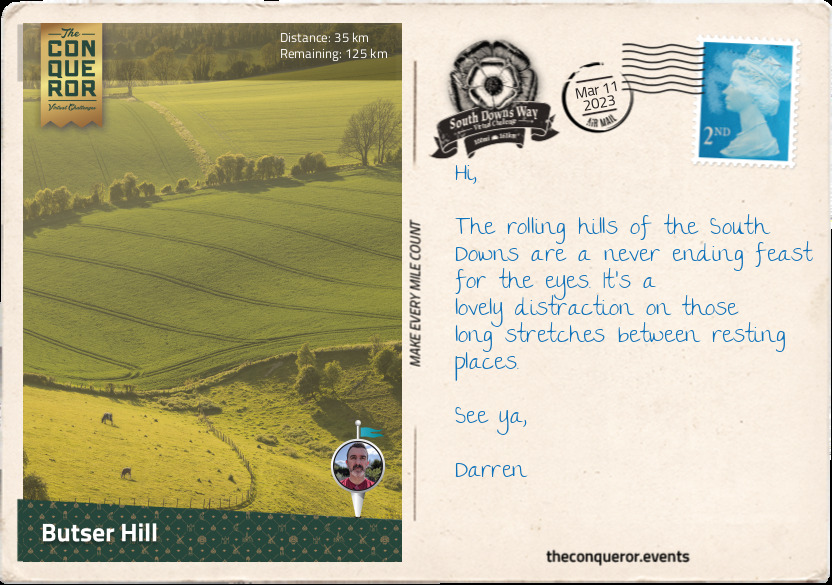
A further 8mi (13km) through the countryside and I arrived at Butser Hill, the original starting point of the Way. At 885ft (270m), Butser Hill is the highest point on the South Downs Way and is home to rare chalk grassland species. A mile further is the Queen Elizabeth Country Park. Designated an Area of Outstanding Natural Beauty (AONB), the park is one of the largest expanses of unbroken forest in the southeast of England. The park’s woodland, mostly beech trees, was planted in the 1930s. The park is twinned with the Queen Elizabeth National Park in Uganda, focusing on cultural exchange, conservation, and supporting local communities.
It’s time for refreshments at the Butser Roundhouse Café. Housed in a replica Iron Age roundhouse, I chose a lemon drizzle cake and a pot of English Breakfast tea. Consulting my map, I got a feel for the next stage of my hike to Amberley.
❤️0
Tags:Conqueror Challenges, Exercise, Walking, Postcard, South Downs
This update was first written by Darren Wall
on Saturday 11th Mar 2023.
Privacy : public